How to Build an Emergency Fund in NZ
Contents (10 sections)
- How much emergency fund do you need in NZ?
- What's your number?
- NZ safety nets that reduce your emergency fund need
- Where to keep your emergency fund
- Best on-call savings accounts for an emergency fund
- How to build your emergency fund from scratch
- Worked example: Building an emergency fund on $55,000
- Emergency fund vs KiwiSaver vs mortgage: what comes first?
- Common questions
- What to do next
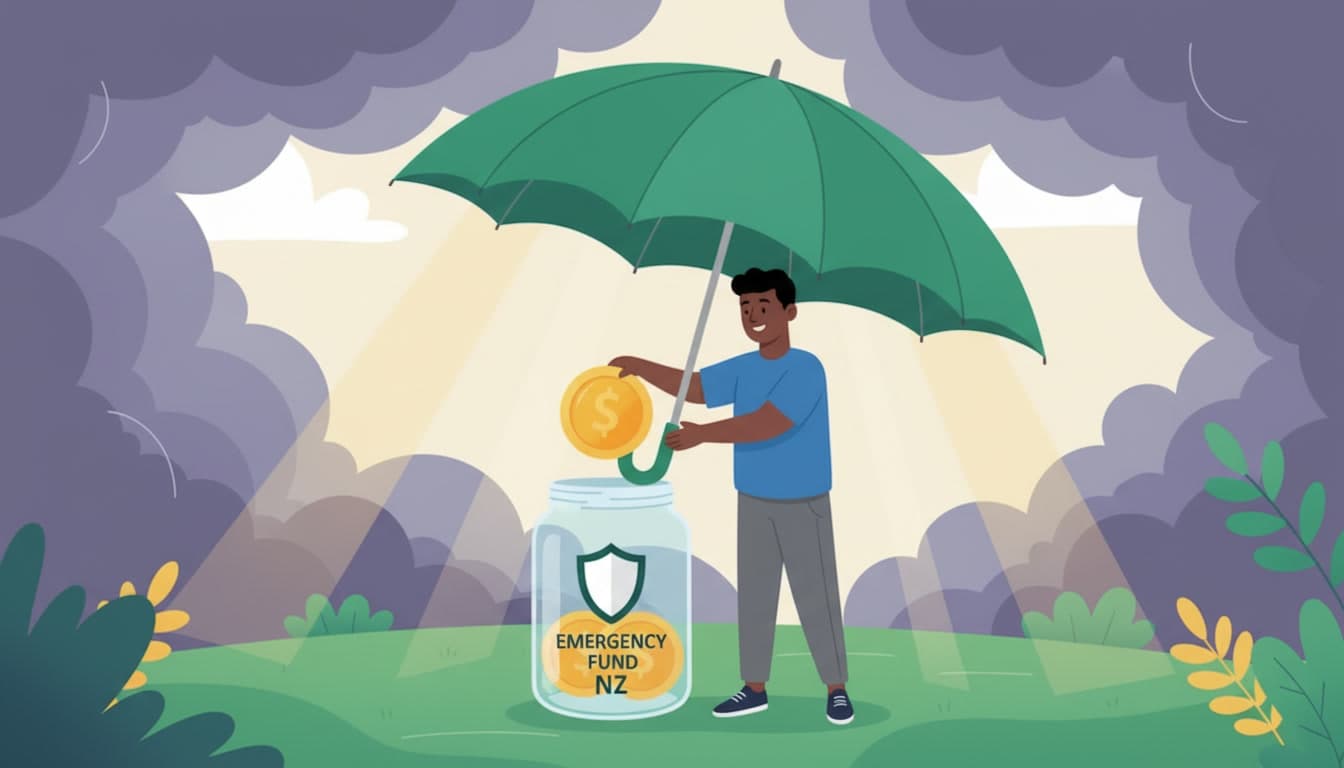
Three to six months of essential expenses, kept in an on-call savings account you can access within 24 hours. That's the target. For most Kiwis, that works out to $7,500 to $18,000. Here's how to figure out your number, where to park the money, and how to build it up from zero.
How much emergency fund do you need in NZ?
The standard rule is three to six months of essential expenses. Not three to six months of income, just the non-negotiable costs: rent or mortgage, food, transport, utilities, insurance, and minimum debt repayments.
Where you sit in that range depends on your circumstances:
| Your situation | Target | Why |
|---|---|---|
| Dual income, no kids, stable jobs | 3 months of expenses | Two incomes means a job loss cuts income by roughly half, not to zero |
| Single income or sole earner | 6 months of expenses | No backup income if something goes wrong |
| Variable or contract income | 6 months of expenses | Income gaps are part of the deal |
| Dual income with dependents | 4 to 5 months of expenses | More fixed costs, but two income streams |
| Self-employed | 6+ months of expenses | No employer-funded sick leave, no employer KiwiSaver contribution |
What's your number?
Here's what different monthly expense levels translate to in emergency fund targets:
| Monthly essential expenses | 3-month target | 6-month target |
|---|---|---|
| $2,000 | $6,000 | $12,000 |
| $2,500 | $7,500 | $15,000 |
| $3,000 | $9,000 | $18,000 |
| $3,500 | $10,500 | $21,000 |
| $4,000 | $12,000 | $24,000 |
| $4,500 | $13,500 | $27,000 |
| $5,000 | $15,000 | $30,000 |
The median NZ household spends roughly $1,300 per week on all costs, or about $5,600 per month (Stats NZ, Household Economic Survey 2023). Essential expenses (housing, food, transport, utilities, insurance) typically make up 60% to 70% of that, putting the essential spend at roughly $3,400 to $3,900 per month for a median household.
If you don't know your monthly expenses, check your last three months of bank statements. Add up rent or mortgage, groceries, power, internet, insurance, transport, and any minimum debt repayments. That's your baseline.
NZ safety nets that reduce your emergency fund need
NZ's social safety net is stronger than many countries in some areas, which means your emergency fund doesn't need to cover everything. But it has gaps.
What NZ covers:
- ACC covers treatment costs and 80% of your income (up to a cap) if you're injured in an accident, whether at work or otherwise (ACC, Accident Compensation Act 2001). Your emergency fund doesn't need to cover workplace injuries the way it would in countries without universal accident cover.
- Public healthcare is free or heavily subsidised for NZ residents. GP visits cost $0 to $70 depending on your age and enrolment, and hospital treatment is free (Ministry of Health). Your emergency fund doesn't need to cover a medical bill that could bankrupt you.
- Jobseeker Support provides $337.74 per week (after tax) for a single person aged 25+ (MSD, as at 1 April 2025). It's not enough to live on comfortably, but it stops the income from dropping to zero.
What NZ doesn't cover:
- Illness or non-accident medical leave beyond your 10 days of employer-funded sick leave per year (Employment NZ). ACC only covers accidents, not illness. If you're off work for three months with a serious illness, you'll need to fund the gap yourself unless you have income protection insurance.
- Redundancy pay is not guaranteed in NZ. There's no legal requirement for employers to provide redundancy compensation unless it's in your employment agreement (Employment NZ).
- Dental, optical, and mental health costs add up fast and aren't well covered by the public system.
The bottom line: NZ's safety net means your emergency fund doesn't need to cover catastrophic medical bills or accident-related income loss. But it absolutely needs to cover job loss, illness, and the costs that fall between the cracks.
Where to keep your emergency fund
Your emergency fund needs to be accessible, safe, and earning a reasonable return. In that order of priority.
| Account type | Typical rate (March 2026) | Access speed | Suitable for emergency fund? |
|---|---|---|---|
| On-call savings account | 3.5% to 4.5% | Instant | Yes, the primary option |
| Notice saver (32-day) | 4.0% to 5.0% | 32 days | Yes, for the bulk of it |
| Term deposit | 4.0% to 5.0% | Locked until maturity | No, defeats the purpose |
| KiwiSaver | Varies by fund | Locked until 65 (with exceptions) | No, not accessible |
| Shares or managed funds | Variable, can lose value | 1 to 5 business days | No, value could drop when you need it |
(Bank websites, RBNZ. Rates are indicative as of March 2026 and vary by provider.)
The best setup for most people:
Keep $1,000 to $2,000 in an instant-access on-call savings account. This is your "the car broke down today" money. The rest goes into a 32-day notice saver, where you'll earn a better rate. If a true emergency hits, you bridge the gap with the instant-access money while the 32-day notice period runs. Most genuine emergencies (job loss, major repairs) have enough lead time that 32 days isn't a problem.
Don't use a term deposit. The whole point of an emergency fund is access. Breaking a term deposit early usually means forfeiting some or all of the accrued interest, and some banks charge an early break fee.
Don't count your KiwiSaver. You can't withdraw it for an emergency unless you qualify for significant financial hardship, which requires a formal application to your provider (KiwiSaver Act 2006, s8). It's not fast and it's not guaranteed.
Best on-call savings accounts for an emergency fund
The big five NZ banks all offer savings accounts, but rates vary. Online-only accounts and smaller banks often pay more.
| Bank | Account | Rate (March 2026) | Minimum balance | Access |
|---|---|---|---|---|
| Kiwibank | Online Call | 3.75% | $1 | Instant |
| BNZ | Rapid Save | 3.50% | $1 | Instant (one free withdrawal/month) |
| Westpac | Online Bonus Saver | 4.10% (with conditions) | $1 | Instant (bonus rate requires no withdrawals) |
| ASB | Savings On Call | 3.50% | $1 | Instant |
| ANZ | Online Savings | 3.50% | $1 | Instant |
(Bank websites, March 2026. Rates change frequently. Conditional rates require meeting deposit or no-withdrawal conditions each month.)
The trade-off with bonus saver accounts: many offer a higher rate on the condition you don't make withdrawals that month. That's fine for building your fund, but if you withdraw for an emergency, you lose the bonus rate for that month. For the emergency fund itself, a straightforward on-call account with no conditions is simpler.
How to build your emergency fund from scratch
If you're starting from zero, the goal is to get to $1,000 as fast as possible, then build steadily towards your full target.
Step 1: Set a mini target of $1,000
This covers the most common emergencies: an urgent car repair, an appliance breakdown, or a vet bill. On a $55,000 salary (roughly $841/week after PAYE, ACC, and 3% KiwiSaver), saving $50/week gets you there in 20 weeks (IRD 2025-26 rates).
Step 2: Automate a weekly transfer
Set up an automatic payment from your everyday account to your emergency fund savings account, timed for payday. The amount matters less than the consistency. Start with whatever you can manage, even $20 per week. That's $1,040 per year.
Step 3: Build to your full target
Once you've hit $1,000, keep the automatic transfer running and increase it when you can. Here's how long it takes at different savings rates (ignoring interest):
| Weekly savings | Time to $7,500 | Time to $12,000 | Time to $18,000 |
|---|---|---|---|
| $30/week | 4 years 10 months | 7 years 8 months | 11 years 6 months |
| $50/week | 2 years 11 months | 4 years 7 months | 6 years 11 months |
| $75/week | 1 year 11 months | 3 years 1 month | 4 years 7 months |
| $100/week | 1 year 5 months | 2 years 4 months | 3 years 5 months |
| $150/week | 11 months 3 weeks | 1 year 7 months | 2 years 4 months |
Those timelines look long at $30/week, but that's okay. An emergency fund is a long-term project if you're on a tight budget. The important thing is having something in place now, even if it's $500.
Step 4: Top it up with windfalls
Tax refunds, work bonuses, birthday money, anything that falls outside your normal income. Direct a portion (or all of it) to the emergency fund until it's fully funded.
Step 5: Stop once you hit your target
Once your emergency fund is at 3 to 6 months of expenses, stop adding to it and redirect the weekly savings to your next priority (debt repayment, house deposit, investing). The fund just sits there, earning interest, until you need it.
Worked example: Building an emergency fund on $55,000
The situation: Single earner, renting in Wellington, no dependents. Monthly essential expenses: $2,800 (rent $1,300, food $450, transport $250, utilities $200, insurance $150, phone/internet $100, minimum loan repayment $350). Target: 3 months = $8,400.
Starting point: $0 in savings. After-tax income of $841/week (on $55,000 salary with 3% KiwiSaver, IRD 2025-26 rates).
The plan:
| Action | Amount | Running total after 12 months |
|---|---|---|
| Automated weekly transfer | $75/week ($3,900/year) | $3,900 |
| Tax refund (average NZ refund approx. $400, IRD) | ~$400 one-off | $4,300 |
| Interest earned at 3.75% | ~$90 | $4,390 |
| 12-month total | ~$4,390 |
After 24 months: approximately $8,100 in savings plus roughly $300 in cumulative interest, totalling about $8,400. Target reached.
What $75/week means in practice: On $841/week take-home, that's 8.9% of income. After rent ($300/week flatting), $466/week covers food, transport, utilities, insurance, minimum loan payments, and personal spending. It's tight, but the emergency fund is a temporary priority with a clear end point.
Emergency fund vs KiwiSaver vs mortgage: what comes first?
If you're juggling multiple financial priorities, here's a practical order:
- Mini emergency fund ($1,000). Before anything else. This stops you going into credit card debt for a small emergency.
- Employer-matched KiwiSaver at the minimum rate. Your employer matches your contribution (at least 3%, rising to 3.5% from April 2026 and 4% from April 2028). Not contributing means leaving free money on the table (IRD, KiwiSaver Act 2006).
- Kill high-interest debt. Any debt above 10% interest (credit cards, personal loans, buy-now-pay-later) costs more than your emergency fund earns. Prioritise paying this off.
- Full emergency fund (3 to 6 months). Once high-interest debt is gone, build the full fund.
- Extra mortgage repayments or investing. Only after the emergency fund is fully funded.
This isn't a rigid formula. If your mortgage rate is 5.5% and your emergency fund earns 4%, the maths slightly favours paying the mortgage. But the emergency fund provides a buffer that prevents you from going into worse debt when something unexpected happens. That peace of mind has real value.
Common questions
How much emergency fund do I need in NZ?
Three to six months of essential expenses. For a single person with $2,500/month in fixed costs, that's $7,500 to $15,000. For a family spending $4,000/month on essentials, it's $12,000 to $24,000. The right amount depends on your income stability, whether you're a sole earner, and whether you have dependents. NZ's ACC cover and public healthcare reduce the need compared to countries without these safety nets.
Where is the best place to keep an emergency fund in NZ?
An on-call savings account with one of NZ's main banks. Look for accounts paying 3.5% to 4.5% (as at March 2026) with instant access and no withdrawal penalties. For the bulk of your fund, a 32-day notice saver offers a better rate while still being accessible enough for most emergencies. Don't use term deposits, KiwiSaver, or investment accounts for your emergency fund.
Can I use KiwiSaver as an emergency fund?
Not easily. KiwiSaver is locked until you're 65, with limited exceptions. You can apply for a significant financial hardship withdrawal, but this requires proving to your KiwiSaver provider that you can't meet minimum living expenses. It's not fast, it's not guaranteed, and it depletes your retirement savings. A separate emergency fund is far more practical (KiwiSaver Act 2006, s8).
How long does it take to build an emergency fund?
At $50/week, you'll reach $7,500 in about 2 years and 11 months (ignoring interest). At $100/week, you'll get there in about 1 year and 5 months. The timeline depends entirely on how much you can set aside. Starting with a $1,000 mini emergency fund (achievable in 10 to 20 weeks for most earners) covers the most common small emergencies while you build towards the full amount.
Is $1,000 enough for an emergency fund?
$1,000 is a good starting point, not the end goal. It covers common emergencies like a car repair, urgent dental work, or a broken appliance. But it won't cover a job loss, which is the biggest financial risk for most people. Think of $1,000 as your "phase one" target while you build towards 3 to 6 months of expenses.
Do I need an emergency fund if I have a mortgage?
Yes. A revolving credit facility or mortgage offset account can technically serve a similar purpose, letting you draw funds back out if needed. But only if your mortgage structure allows it. If your entire mortgage is on fixed terms, you can't access extra repayments without breaking the term. A separate emergency fund is simpler and guaranteed to be accessible when you need it.
What counts as an emergency?
Job loss, urgent medical or dental costs, essential car or home repairs, unexpected travel for a family emergency. Not a sale on flights, not a new phone, not Christmas. The test: is this unexpected, urgent, and necessary? If you're dipping into it regularly, the problem is usually a budgeting gap, not a string of emergencies. Savings strategies that work can help with that.
Is an emergency fund worth it when interest rates are lower than my mortgage rate?
The return on an emergency fund isn't the interest rate. It's avoiding 20%+ credit card debt, personal loan interest, or KiwiSaver hardship withdrawals when something goes wrong. Even if your emergency fund earns 4% and your mortgage costs 5.5%, the 1.5% difference on $10,000 is $150/year. That's cheap insurance against a financial setback that could cost thousands.
What to do next
- Calculate your take-home pay to figure out how much you can realistically save each week
- Savings strategies that work in NZ for broader tips on building savings alongside your emergency fund
- KiwiSaver contribution rates to check you're getting your full employer match
- Debt repayment strategies if you're balancing an emergency fund with paying off debt
Last updated: 1 March 2026. Sources: IRD (ird.govt.nz), RBNZ (rbnz.govt.nz), ACC (acc.co.nz), MSD (msd.govt.nz), Stats NZ (stats.govt.nz), Employment NZ (employment.govt.nz), Ministry of Health (health.govt.nz), bank websites. Rates are indicative and change frequently. This is financial information, not financial advice.
Continue Reading

This is educational content, not financial advice.